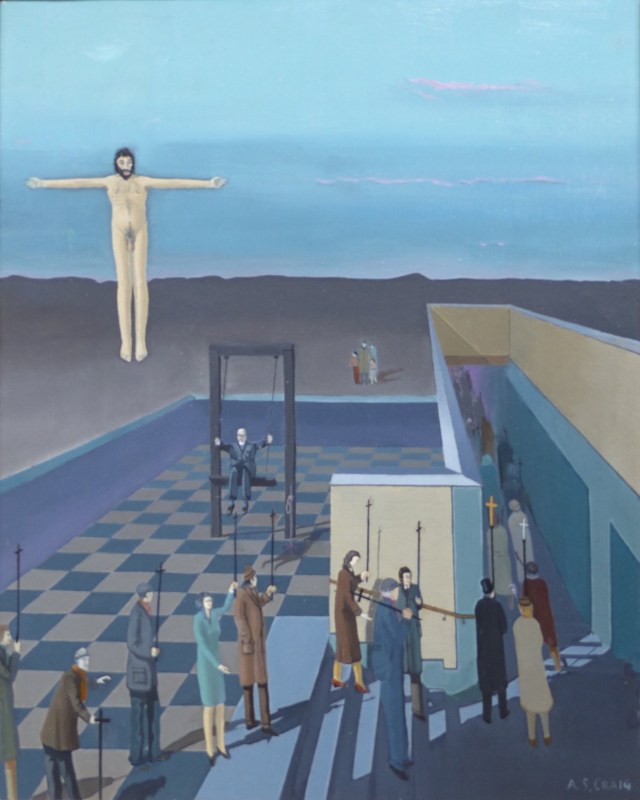
A picture meant to shock.
At the time it was created (1973), religious observance was much more prevalent than nowadays. But this is also a topical picture, especially in our times where we see chaos wrought by blind adherence to fundamentalist beliefs of any stripe.
A surreal vision certainly but one which reflects the atheistic views of the artist, who skilfully adopts the trope of the Returned Christ (The Homeless One) bemusedly hovering over his flock and witnessing their enslavement to a dogma which has moved far from its original purpose.
Since this is a home-grown British surrealism, it is peopled with quotidian characters which have echoes more of Lowry than Dali. However there are hints of the Spanish master in the strange geometrical architecture that encloses the protagonists and the bare, barren plain beyond.
The artist, as with so many of his pictures, presents us with a God’s eye view of his tableaux. We stare down upon a procession of cross-bearing supplicants entering into a kind of Heaven. But what a bleak, cheerless and disappointingly mundane reward it is – depressingly reminiscent of a municipal carpark.
All is overseen by the inscrutable Christ, instantly identifiable in his cruciform pose. But this is a Messiah more exposed and nakedly vulnerable than before. His sacrificial pose is replicated by His earthly agent, the minister, who the artist wittily mocks by placing him on a playground swing, thus devaluing his calling. This is a bleak vision of religious faith and offers no comfort to the hesitant or the agnostic, represented by the lonely family left outside on an empty plain.
Formally the viewer’s eye is attracted by some marvellous inventions – the flitting shadows which descend across the flight of steps leading to the tunnel entrance – the tiny detail of the elderly man who uses his cross as a walking stick. There is power in the skilfully blended surfaces and immaculately sharp edges. The composition, as in so many of the artist’s pictures, is dominated by a strong horizon line. Some clichés of Surrealist art do appear, such as the chequered flooring, but they do not detract from the overall effect. AS Craig’s message dominates and warns against the dangers of blind surrender to the doctrine of the supernatural.
Artist: AS Craig
Dimensions: 48 x 58 cm
Medium: Oil on board
Year: 1973
Analysis: Mark Robinson, artist based in Penarth
 AS Craig